


UHF RFID Errors: A Physics Problem or a Metaphysical Puzzle?
Late at night in a modern logistics warehouse, automated guided vehicles glide quietly between aisles, reader antennas sweeping across shelves as inventory data streams onto monitoring screens. Sometimes the numbers are reassuringly precise. Other times, they fluctuate without warning, devolving into missed reads and unexpected gaps.
In the control room, engineers debate the cause. One proposes adding more antennas. Another argues for a better anti-collision algorithm. The project manager stares at the dashboard in disbelief: “Last month we were at 99.3% accuracy. How are we down to 87% this week?”
Meanwhile, on the warehouse floor, a veteran manager with decades of hands-on experience calmly offers advice to a new hire: “Metal shelves always cause problems—read them in separate passes. Liquids work best around midday. Morning humidity kills the signal.”
To some, this sounds like superstition. To others, it sounds uncomfortably accurate.
So what’s really going on here? Are UHF RFID errors purely a technical issue—or is there something deeper at play?

1. The Reality Check: When Lab Science Meets the Warehouse Floor
UHF RFID specifications are undeniably impressive. Ten-meter read ranges. Hundreds of tags per second. Near-perfect accuracy. All of these claims are true—in controlled laboratory conditions.
The problem is that warehouses are not laboratories.
Metal reflects RF energy. Liquids absorb it. Dense packaging creates unpredictable multipath effects. Stacked pallets turn ideal signal propagation into a chaotic environment where energy decays exponentially, not linearly. Tags buried deep inside loads often receive just enough power to wake up, but not enough to respond reliably.
In practice, many tags operate in a persistent state of marginal activation—alive, but struggling. This is not a failure of technology; it’s a consequence of physics.
2. A Different Lens: Yin, Yang, and the Warehouse Environment
If you view the system strictly through engineering equations, you see readers, tags, RSSI values, and collision algorithms. But through another lens—one rooted in systems thinking—the picture looks surprisingly familiar.
The reader is active, transmitting, dominant. The tags are passive, responsive, dependent. One provides energy; the other receives it. This is a classic asymmetric system.
Metal and liquid goods consistently introduce instability. They distort, absorb, and scatter RF energy. Some environments amplify signals. Others suppress them. Over time, experienced operators learn these patterns intuitively, even if they can’t express them mathematically.
What may sound like “warehouse folklore” is often the result of long-term empirical observation. Different zones behave differently. Different materials require different strategies. Treating the entire warehouse as a uniform RF environment is a fundamental mistake.
3. Where Errors Really Come From
When tags are missed during inventory, engineers correctly cite causes such as:
Multipath interference and phase cancellation
Dense tag populations overwhelming anti-collision protocols
Poor tag orientation or polarization mismatch
Signal attenuation from packaging and materials
All of these are valid explanations. But they point to a broader truth: errors emerge when system components fail to interact effectively with their environment.
A pallet stacked too tightly can shield inner tags entirely. Reference tags placed too close together can interfere with one another. Stronger power does not always mean better performance—it often increases noise and reflections.
In other words, many RFID failures are not isolated technical defects. They are systemic imbalances.

4. Anti-Collision: Order from Chaos
One of the most dramatic moments in any RFID system is the instant a reader energizes hundreds or thousands of tags at once. From a technical standpoint, this is where anti-collision algorithms earn their keep.
But no algorithm can eliminate chaos instantly. It must sequence responses, resolve contention, and extract order from noise over time. Some tags will respond immediately. Others will surface only after repeated passes.
This is not inefficiency—it is reality. Large-scale RFID systems are probabilistic by nature. Expecting instantaneous, perfect reads under dense conditions is fundamentally unrealistic.
5. Parameter Tuning: Why “More” Is Often Worse
Inexperienced deployments often fall into the same traps:
Increase power to solve weak reads
Slow inventory cycles to reduce misses
Add more reference tags to improve accuracy
Each of these can help—up to a point. Beyond that point, they begin to undermine the system.
Excessive power amplifies reflections. Slower cycles reduce throughput. Too many reference tags introduce additional interference. Optimization is not about maximizing individual parameters; it is about finding equilibrium.
The most reliable systems are tuned holistically. Power, speed, density, antenna placement, and process timing are adjusted together, iteratively, and with respect to environmental behavior.
Interestingly, experienced warehouse managers often arrive at nearly the same settings through intuition that engineers reach through months of testing. Different paths—same destination.
6. Accepting Uncertainty—and Designing for It
Perhaps the most important realization for any serious RFID professional is this: 100% accuracy is not a realistic goal.
Not because the technology is flawed, but because the physical world is inherently variable. RF behaves differently across time, space, temperature, humidity, and materials. Cost constraints further define what levels of redundancy are practical.
Mature systems acknowledge this. They aim for defensible thresholds—98–99% inventory accuracy, predictable positioning tolerances—and then compensate at the process level through redundancy, exception handling, and smart workflows.
Robust systems are not those that deny uncertainty. They are the ones designed to absorb it.

Conclusion: Where Engineering Meets Wisdom
The most successful RFID deployments don’t rely solely on equations or intuition—they combine both.
When teams begin segmenting warehouses by material type, applying different read strategies to different zones, and tuning parameters dynamically, they are practicing advanced RF engineering—even if they don’t call it that.
Electromagnetic waves move at the speed of light. Experience accumulates slowly. When the two finally align, system performance stabilizes, dashboards turn green, and the debate quiets down.
Call it physics. Call it systems thinking. Call it wisdom earned the hard way.
In the end, the result is the same:
A system that works—not because it’s perfect, but because it understands its environment.

Winker Wang
Owner of RexID, a division of Freevision Technologies, has over 23 years of experience in the RFID industry. He has been instrumental in advancing 125KHz,13.56MHz, and UHF RFID technologies worldwide. With a relentless drive for innovation, Winker shares insights on RFID security, credential advancements, and access control.
Featured Products
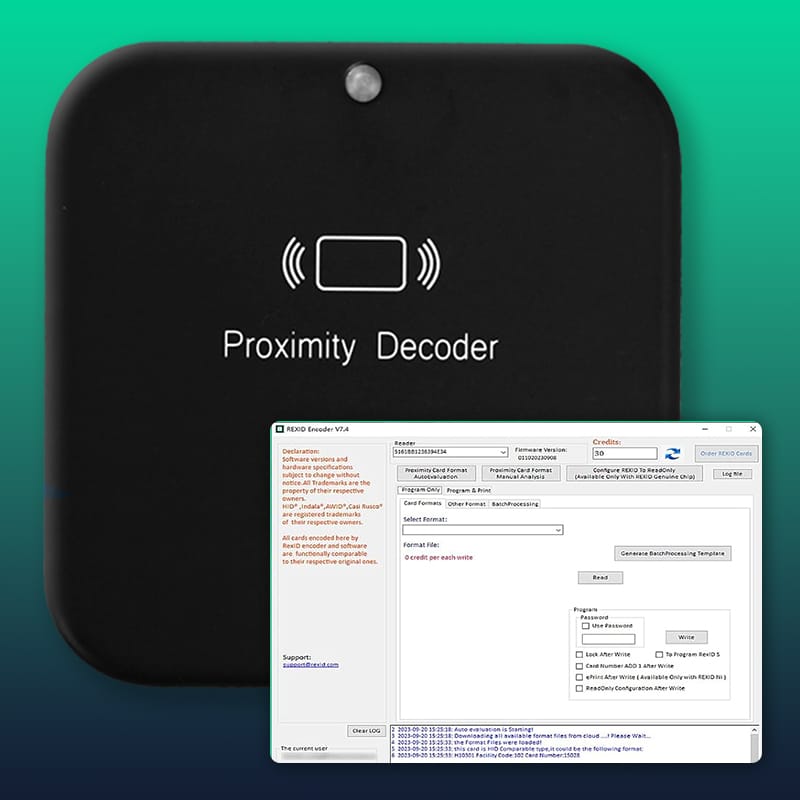
RFID Decoder
Decode & encode 125 kHz RFID credentials for ISO cards, clamshell cards, & fobs.
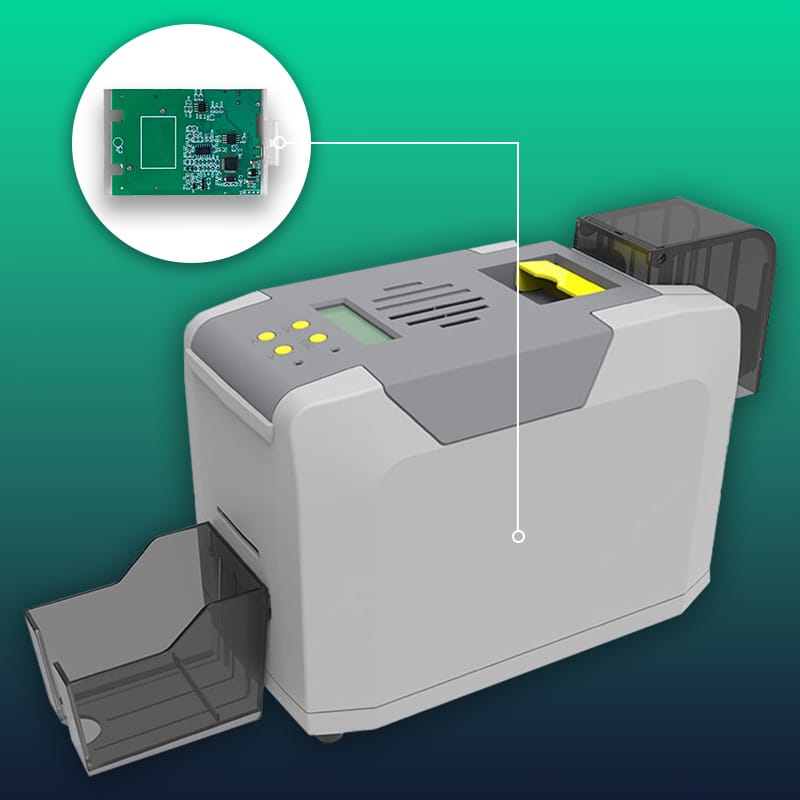
Custom Encoding
Encode & print ISO cards on demand in 60+ formats with facility code & card numbers.

Gateway Reader
Upgrade 125 kHz systems to mobile-friendly access with no downtime & added security.
Stay Updated & Save
Get new releases and exclusive discounts delivered to you!
Recent Posts
Stay Connected


Elevate Tour Brand Quotient
Follow Us On


Contact
FREEVISION TECHNOLOGIES CORP.


10080 N Wolfe Road, Ste. SW3-200,
Cupertino, CA 95014
© 2026 Rexid, All Rights Reserved.
Elevate Tour Brand Quotient
Follow Us On
Contact
FREEVISION TECHNOLOGIES CORP.
10080 N Wolfe Road, Ste. SW3-200,
Cupertino, CA 95014
© 2026 Rexid, All Rights Reserved.
Elevate Your Brand Quotient
Follow Us On
Contact
FREEVISION TECHNOLOGIES CORP.
10080 N Wolfe Road, Ste. SW3-200,
Cupertino, CA 95014
© 2026 Rexid, All Rights Reserved.