


Access Card Formats: The Key to Security
Physical access cards carry a secret code that grants employees, visitors, and designated personnel access to authorized areas.
But did you know that behind these simple cards lies a complex system powering modern technologies?
How Does It Work?
Cards come in different formats, each with its own intricate inner workings. These formats store crucial information—mysterious to outsiders but essential for security.
Wait a Bit
Remember what a bit is?
Let’s take a step back and draw inspiration from computers.
Computers use bits to encode information. A bit is either 0 or 1. A 2-bit system has four possibilities: 00, 01, 10, 11.
For a 3-bit system, the combinations expand to: 000, 001, 010, 011, 100, 101, 110, 111—eight possibilities.
This scales quickly. How do you calculate the number of possible values?
Here’s the formula: for an N-bit system, the number of possible values is 2^N. If you put on your middle school hat, the math makes perfect sense.
Don’t underestimate this simple math—it adds up like magic.
For a 20-bit system, there are 1,048,576 unique values.
Bits are the foundation of computer technologies—and, you guessed it, access control systems.
From Computers to Access Control
In a typical 26-bit RFID format, the structure is divided into specific fields that define card details and access rules. This widely used format powers proximity cards and access control systems.
Here’s a breakdown of a standard 26-bit format:
Parity Bits (1 bit each, first and last bit)
The first and last bits ensure data integrity by checking if the total number of 1s is even or odd.
Facility Code (8 bits)
Groups cards by facility or building.
An 8-bit field allows for 256 unique binary data, represented by decimals 0-255.
Card Number (16 bits)
A unique identifier for the card.
A 16-bit field allows for 65,536 unique binary data, represented by decimals 0 to 65,535.
Example of a 26-bit RFID ID
If an RFID ID is represented in binary as: 1 00011010 0101010101010101 1
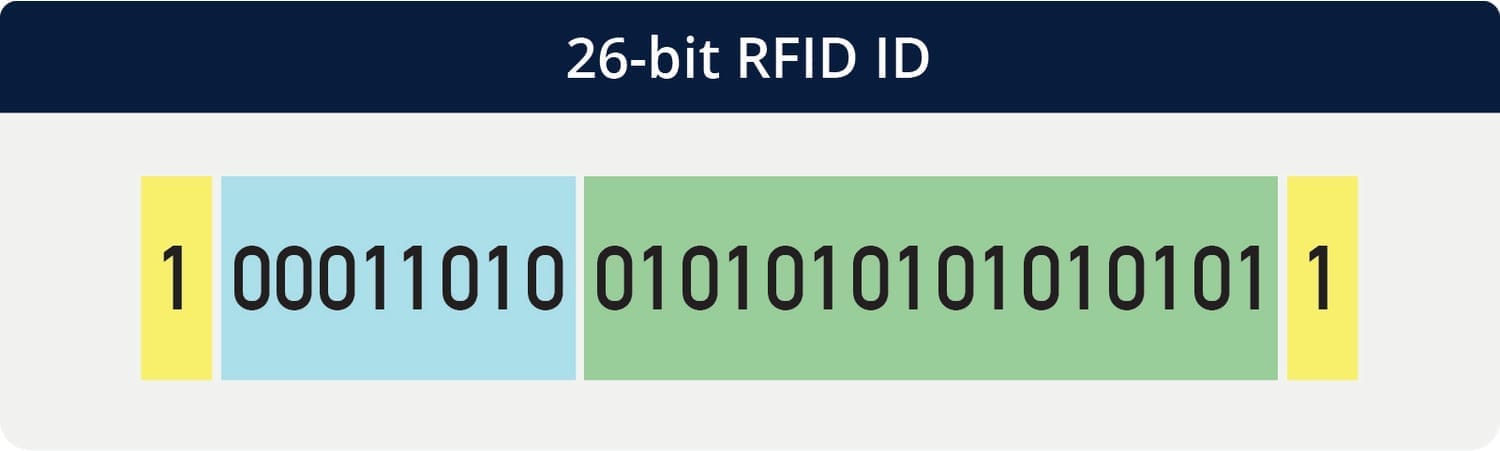
Leading Parity Bit: 1
Facility Code: 00011010 (26 in decimal)
Card Number: 0101010101010101 (21,845 in decimal)
Trailing Parity Bit: 1
This system enables over 67 million unique card IDs (since 2^26 = 67,108,864).
And this is just one of the most popular formats—H10301. There are dozens more, each with its own structure and rules.
The Challenge: Expanding Your Access System
When adding new cards to your existing system, how do you know the correct format and facility code?
Many businesses are left in the dark:
They’ve lost contact with the original installers.
The original provider has gone out of business.
Even if they find the installer, they’re charged an arm and a leg for additional cards.
The Solution: RexID Encoder/Decoder
After 10 years of research, we’ve developed the easiest way to decode and encode proximity cards.
Our RexID encoder/decoder allows you to:
✅ Identify the format, facility code, and card number of an existing card. ✅ Generate matching cards for your system. ✅ Take control of your access security—without expensive middlemen.
See our decoder in action in this quick demo.
With this tool in hand, you gain the confidence to manage your system and expand seamlessly. The best part, you do not need to understand a “bit”!

Winker Wang
Owner of RexID, a division of Freevision Technologies, has over 23 years of experience in the RFID industry. He has been instrumental in advancing 125KHz,13.56MHz, and UHF RFID technologies worldwide. With a relentless drive for innovation, Winker shares insights on RFID security, credential advancements, and access control.
Featured Products
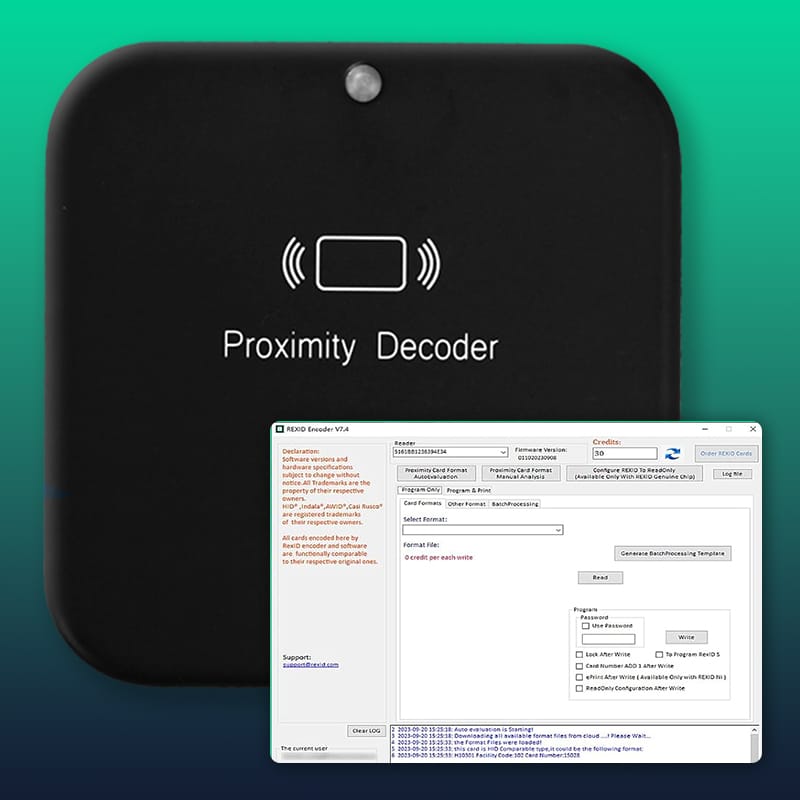
RFID Decoder
Decode & encode 125 kHz RFID credentials for ISO cards, clamshell cards, & fobs.
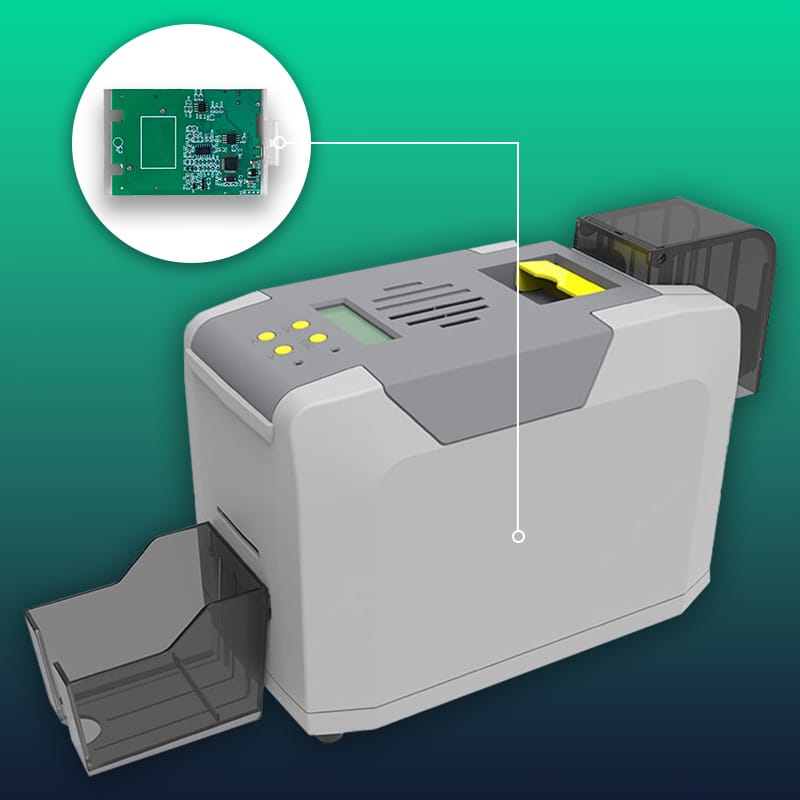
Custom Encoding
Encode & print ISO cards on demand in 60+ formats with facility code & card numbers.
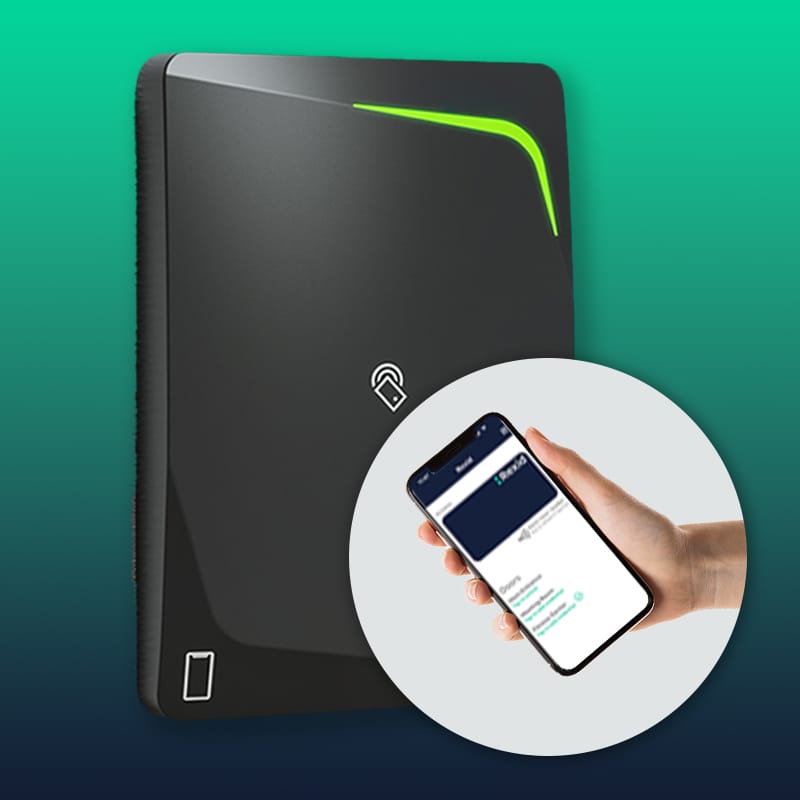
Gateway Reader
Upgrade 125 kHz systems to mobile-friendly access with no downtime & added security.
Stay Updated & Save
Get new releases and exclusive discounts delivered to you!
Recent Posts
Stay Connected


Elevate Tour Brand Quotient
Follow Us On


Contact
FREEVISION TECHNOLOGIES CORP.


10080 N Wolfe Road, Ste. SW3-200,
Cupertino, CA 95014
© 2026 Rexid, All Rights Reserved.
Elevate Tour Brand Quotient
Follow Us On
Contact
FREEVISION TECHNOLOGIES CORP.
10080 N Wolfe Road, Ste. SW3-200,
Cupertino, CA 95014
© 2026 Rexid, All Rights Reserved.
Elevate Your Brand Quotient
Follow Us On
Contact
FREEVISION TECHNOLOGIES CORP.
10080 N Wolfe Road, Ste. SW3-200,
Cupertino, CA 95014
© 2026 Rexid, All Rights Reserved.